

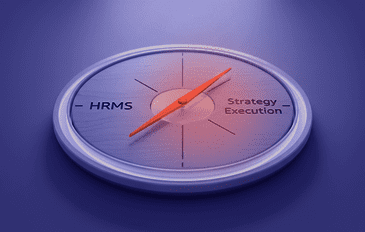
The Execution Gap: Why Strategy Fails Inside Organizations

Strategy & Execution

The Execution Gap: Why Strategy Fails Inside Organizations

Author
Artur Torosyan
Co-Founder & CTO of Spark.work
Artur has nearly two decades of experience in software engineering and system architecture. He focuses on building systems that connect strategy, people, and performance into a unified execution layer for modern organizations, with a strong emphasis on AI-orchestrated business operations.
Share with your community!

In this article

Strategy Has Never Been Easier

Over the years, I’ve seen how much time leadership teams invest in strategy. Companies run strategy workshops, define ambitious goals, and create detailed roadmaps for the future. Frameworks like OKRs and KPIs are now widely used across industries, and leadership teams spend significant time aligning on priorities and defining the direction of the company.

On paper, everything looks structured and clear. Yet something strange keeps happening. Despite all the planning, many strategies still fail during execution. Not because the strategy was wrong, and not because the goals were unrealistic, but because organizations struggle to translate strategy into coordinated, day-to-day execution.

This gap between planning and reality is what I refer to as the execution gap.

I’ve seen this problem from both sides. As a CTO, I’ve worked with leadership teams that had strong strategies and talented people, yet still struggled to keep execution aligned across the organization. Even inside fast-growing technology companies, we often discovered that the challenge wasn’t defining the strategy. The challenge was making sure that hundreds of small daily decisions across teams were actually moving in the same direction.

To understand why this happens so often, we need to look at what occurs once strategy moves from leadership discussions into everyday work.

The Execution Gap

The execution gap is the distance between what leadership plans and what actually happens inside the organization. At the leadership level, things usually look well organized.

  • Strategic goals are defined
  • OKRs are documented
  • KPIs are established
  • Initiatives are approved

But once execution begins, things often become less clear. Teams start working in silos. Information becomes fragmented. Progress becomes difficult to track, and important signals arrive too late.

Over time, a familiar pattern appears in many organizations:

  • Strategy reviews reveal unexpected problems
  • Leaders discover issues too late
  • Teams lose alignment
  • Goals slowly drift away from reality

By the time leadership realizes something is wrong, the quarter—and sometimes even the entire year—has already been compromised.

A large part of this problem does not come from people or processes. It often comes from how organizations structure the systems they use to manage work.

Why Traditional Tools Don’t Solve the Problem

One of the main reasons behind this gap is how organizations structure their technology. Most companies rely on a collection of separate tools.

  • HR systems manage employee data
  • Project management tools track tasks
  • Strategy tools document OKRs
  • Communication platforms manage discussions
  • Analytics tools generate reports

Each of these tools works well within its own domain. But very few organizations have a system that truly connects strategy to daily execution.

A strategic goal might exist in a strategy document. An OKR might be tracked somewhere else. Tasks live inside a project management tool. Performance metrics appear in reports. These systems rarely communicate in a way that reflects how work actually happens inside the organization.

As a result, companies lose something extremely important: execution visibility.

Because these systems are fragmented, organizations often rely on another mechanism to understand what is happening—reporting.

Make strategy something your teams can actually execute, measure, and improve.

Execution Is Not the Same as Reporting

Many organizations rely heavily on periodic reports to understand progress.

  • weekly updates
  • monthly reviews
  • quarterly performance summaries

But reporting only tells you what has already happened. Execution requires something very different. It requires continuous awareness of what is happening inside the organization right now.

Leaders need to be able to answer questions such as:

  • Are initiatives moving forward?
  • Are key results progressing as expected?
  • Are teams blocked somewhere?
  • Are priorities shifting?

By the time a quarterly report reveals a problem, the organization is already reacting to the past instead of shaping the present. Execution should not depend on delayed summaries. It should be observable as work unfolds.

When you step back and look at the pattern, it becomes clear that something fundamental is missing.

The Missing Layer: Strategy-to-Execution Systems

Over time, I’ve come to believe that many organizations are missing a critical layer in their technology. They have systems for HR, tools for project management, and documents describing strategy. But they often lack a system designed specifically for execution.

A true strategy-to-execution system should allow leaders to see how work flows from high-level strategy all the way to individual contributions.

Strategy → Objectives → Key Results → KPIs → Initiatives → Tasks → Daily execution

When these layers are connected, something powerful happens. Leaders gain clarity. They can understand:

  • how strategy translates into real work
  • where execution slows down
  • which initiatives actually move the business forward
  • where risks begin to emerge

Instead of relying only on retrospective reports, they can observe execution as it happens.

Fortunately, this problem is becoming increasingly visible, and the industry is slowly moving toward a better approach.

From Tools to Business Operating Systems

We are gradually entering a new phase in how organizations operate. In the past, companies relied on isolated tools that managed separate functions. Today, we are moving toward something different.

Organizations are beginning to adopt business operating systems—platforms that connect strategy, people, and execution in a unified environment.

These systems make it possible to:

  • align teams around shared goals
  • connect strategy with operational work
  • observe execution continuously
  • detect risks earlier
  • adapt more quickly when conditions change

This shift is not just technological. It represents a deeper transformation in how organizations operate. Execution becomes visible, measurable, and continuously improvable.

Closing the Execution Gap

In the coming years, the organizations that succeed will not necessarily be the ones with the most sophisticated strategy. They will be the ones that execute consistently and adapt quickly.

Closing the execution gap requires:

  • visibility across the organization
  • alignment between strategy and daily work
  • continuous feedback loops
  • systems designed for execution, not just administration

Strategy defines direction. Execution determines the outcome.

And the organizations that learn to execute well will ultimately shape the future of business.

Tell your friends
Don’t Just Read About It. Run It.
Turn strategy into measurable action with Spark.work.
More Articles to Explore
HR
HR trends in 2026

AI is everywhere in 2026, but the real shift in HR is happening somewhere far more human.