
North Stars & Cycles
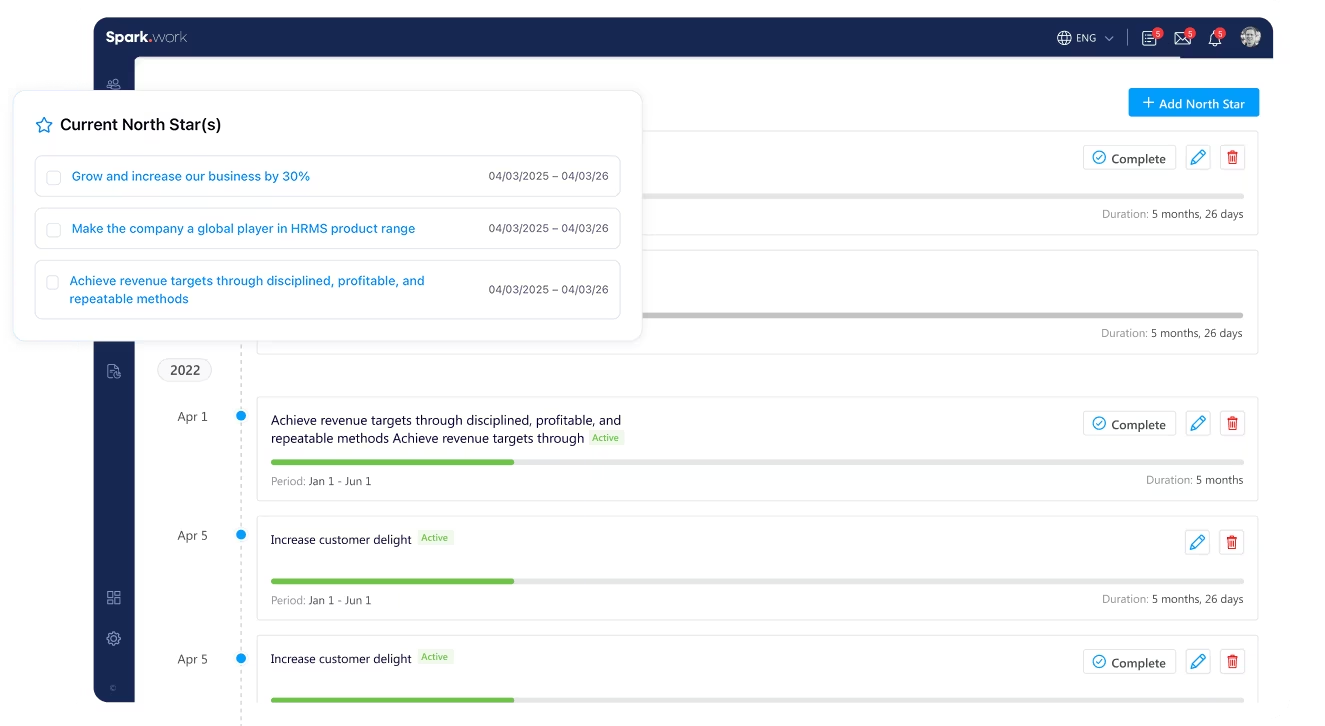
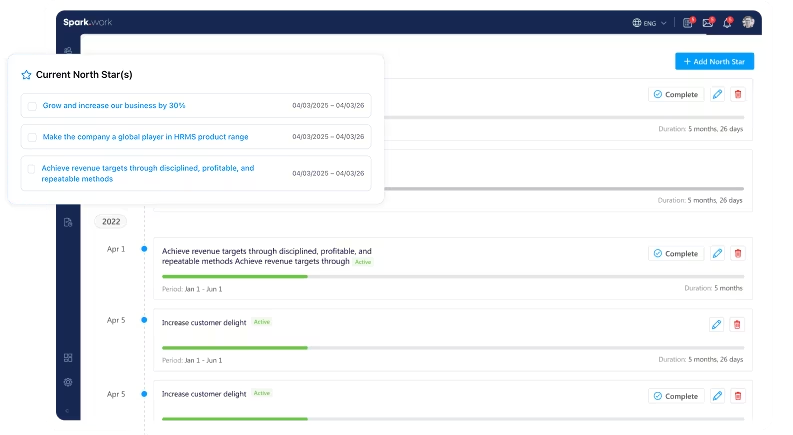
Executive Clarity and Control

Ensure that every strategic priority has a clear executive owner responsible for direction, coordination, and results.
Respond to market shifts and external volatility without losing strategic direction or organizational focus.
Track real movement toward long-term goals and maintain momentum across planning cycles.
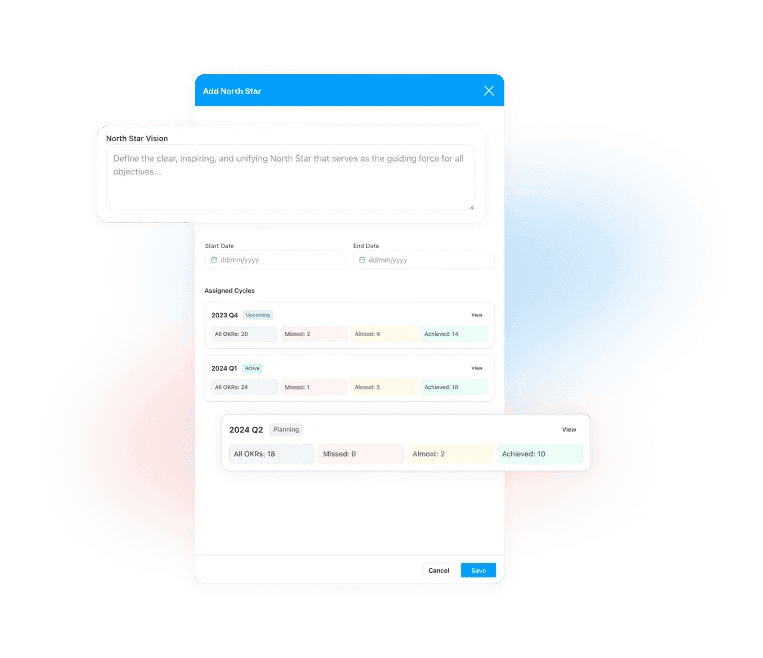
The North Star That Aligns the Year
A North Star defines the single outcome that organizes the next 12 months. It connects long-term vision with quarterly execution and gives direction to every OKR.
- Define the Year’s Strategic Outcome
Clarify what “winning this year” actually means for the organization.
- Anchor OKRs to One Direction
The North Star sits between vision and quarterly cycles, ensuring every OKR contributes to the same strategic result.
- Create Strategic Continuity
Maintain momentum across quarters so each cycle compounds toward a clear direction.
- Force Real Strategic Trade-Offs
Priorities become explicit. Capital, focus, and initiatives align around one organizing outcome.
- Make Strategy Tangible
A 12-month horizon is long enough to create meaningful impact and short enough to adapt when conditions change.
Cycles That Turn Strategy Into Momentum
Cycles are not static quarters. They are focused execution sprints that move the organization toward the North Star while adapting to reality.
- Define Focused OKRs for Each Cycle
Translate strategic direction into clear, time-bound objectives for the current execution period.
- Adapt to Market Signals
Adjust priorities as external conditions, opportunities, and constraints evolve.
- Test and Refine Assumptions
Use each cycle to validate strategy and improve the decisions guiding execution.
- Reallocate Effort Where It Matters
Shift resources and attention to the initiatives that drive the greatest impact.
- Build Momentum Through Iteration
Execution follows a continuous loop: commit, execute, measure, adjust, and reinforce.
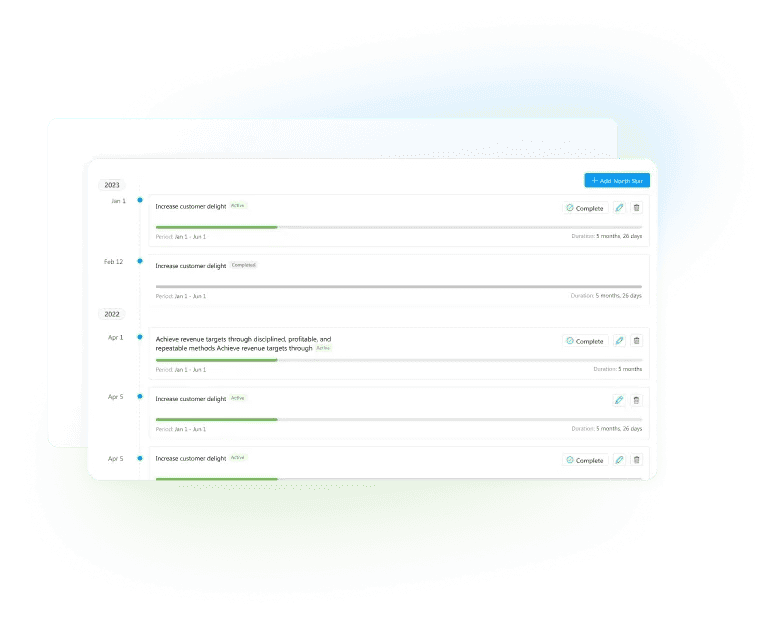
North Star + Cycles = Strategic Agility
A Balanced Way to Turn Long-Term Direction into Adaptive Execution
Have More Questions? We've Got You Covered
A North Star is the defining outcome for the year that guides all strategic work.
It sits between long-term vision and quarterly execution, giving context to OKRs and ensuring every cycle contributes to a shared direction.
A Key Result measures progress toward an objective within a cycle.
A North Star defines the strategic outcome the organization is working toward over the next 12 months.
It provides direction for multiple OKR cycles.
Twelve months is long enough to create meaningful strategic progress but short enough to remain adaptable.
Shorter horizons become tactical.
Longer horizons often become abstract.
Cycles are focused execution periods where teams define OKRs, measure progress, and adjust priorities.
They allow organizations to move toward the North Star while responding to market changes and new information.
The North Star provides stability and direction.
Cycles provide adaptability and execution speed.
Together they create a structured rhythm of commitment, execution, measurement, and adjustment.
Traditional planning often locks strategy into static annual plans.
The North Star defines direction, while cycles allow teams to continuously adapt execution without losing strategic focus.
No. Any organization that wants clearer direction and faster strategic execution can benefit from defining a North Star and running focused execution cycles.
The structure simply scales with the organization.
Spark.work connects North Stars, cycles, OKRs, KPIs, and initiatives into one execution system.
This allows leadership to see how strategy translates into work across the organization and where adjustments are needed.
Bring Clarity to Your Strategic Direction
When direction and execution disconnect, strategy becomes noise. See how North Stars and Cycles create alignment, momentum, and measurable progress.