One competency library
A central set of definitions instead of per-department copies that drift apart. Competencies are grouped into categories, written once, and mapped to the roles that need them, so the framework the HR team maintains is the same one a manager sees in a review and the same one a career path is built from. There is no second copy to keep in step.
- Competency library
- Competency categories
- Competency mapping to roles
- Learning and career tools
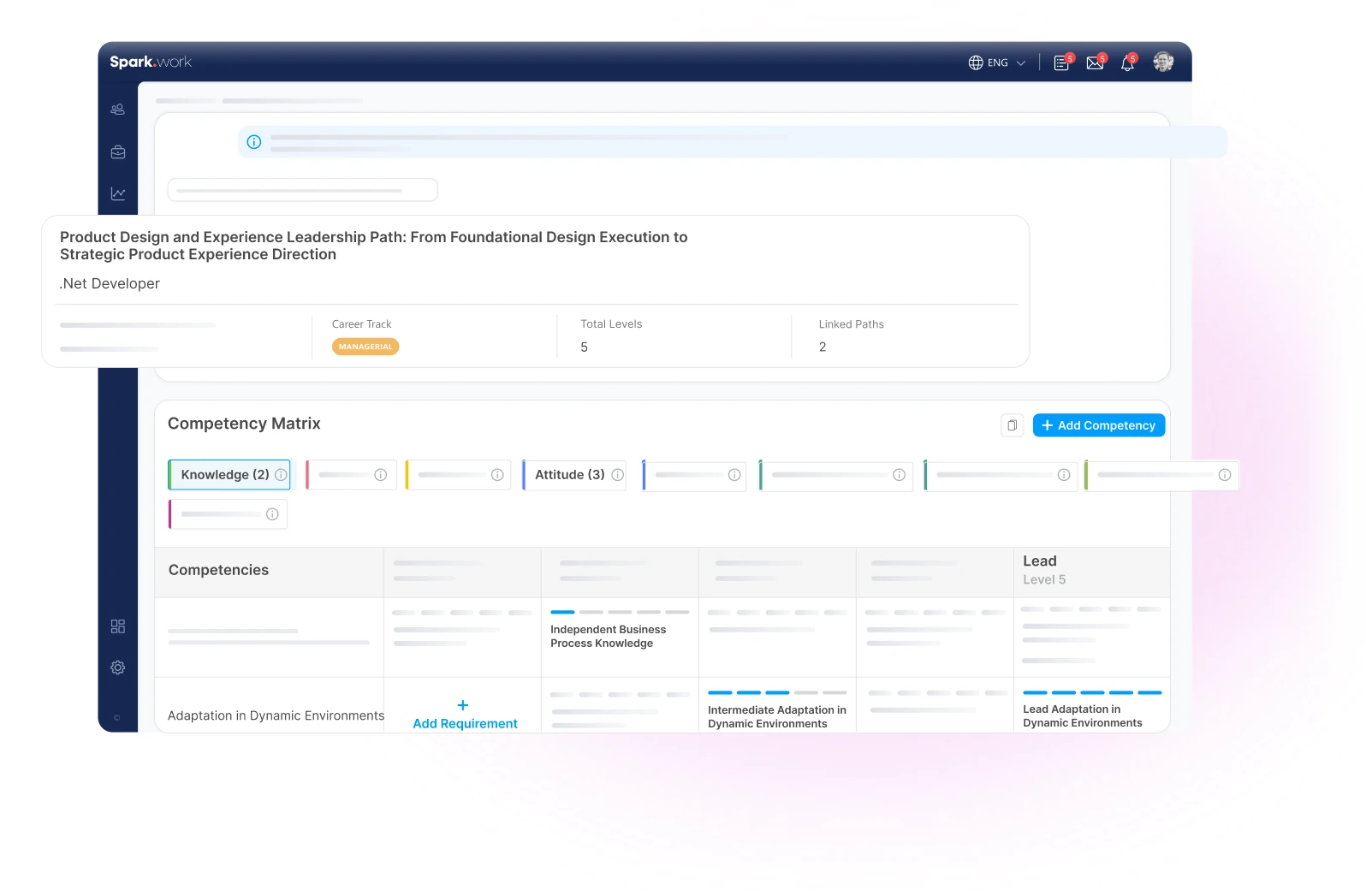
A competency matrix with expectations by level
Make progression explicit: what is expected of a person at each level of a path, written down once and visible to the people it applies to. The competency matrix is the grid behind that - roles down one axis, competencies across the other, and the proficiency expected in each cell. It is what turns not quite ready for senior into a conversation about three named competencies.
- Competency matrix
- Proficiency levels
- Career paths
- Position management
Competency assessment against the framework
Where a person stands, using the same definitions everyone else is measured against. Assessment can come from the manager, from the individual, or from a 360 that collects input from the people who actually work with them. The result lands on a competency profile that sits with the rest of the employee record rather than in a separate assessment tool.
- Competency profile
- Self and manager assessment
- 360 reviews
- Performance assessment
Competency tracking and skills gap analysis
Once people are assessed against the same framework, the gaps stop being anecdotal. Compare the proficiency a role expects against the proficiency a team actually holds, by department, position or individual, and the picture is a report rather than an opinion. That is the input to a development plan for one person and to a hiring or training decision for a whole function.
- Skills gap analysis
- Coverage by team and position
- Workforce analytics and tracking
- HR reporting
Use it in real conversations
A framework earns its keep in review and development conversations, not in an annual audit. Because the definitions are shared, a one-on-one can open on a named competency, a development plan can target it, and the next review cycle can check whether it moved. The framework stays current because something depends on it every month.
- Performance management
- Goals and development plans
- One-on-one meetings
- 9-box grid
Competencies in hiring
The same definitions can shape what you hire for, so internal and external standards match. A requisition can be written against the competencies the role expects, candidates can be assessed on them, and whoever joins is already positioned on the framework their first review will use - instead of being measured against one standard at interview and a different one six months later.
- Recruitment
- Assessments and surveys
- Job requisitions
How competency management works in Spark.work
Competency management in Spark.work runs as one loop rather than a document. The library defines each competency and its proficiency levels; the matrix maps those competencies onto roles and levels; assessment - self, manager and 360 - places each person against that map; the gaps that fall out drive development plans, learning and career paths; and the next review cycle reads from the same definitions. Nothing is re-entered between those steps, which is the reason a framework survives its first year.
- One library, reused by every other module
- Proficiency levels defined per competency
- Assessment from several sources on one profile
- Gaps feeding development plans and career paths
Who it is for
Built for mid-size organizations that have outgrown a competency spreadsheet but do not want a standalone skills tool bolted onto an HR system: HR teams maintaining a framework across several departments, managers who need to say what good looks like at the next level and mean something specific by it, and leadership that wants capability and headcount read from the same data. Spark.work is used by telecom, software and professional services companies, including Ucom, EasyDMARC and Volo.
- HR teams maintaining a framework across departments
- Managers running level and progression conversations
- Organizations replacing a competency spreadsheet
- Leadership planning capability alongside headcount